A low-maintenance garden does not come from a list of tough plants. It comes from decisions made at the drawing stage, most of them before a single plant is chosen. These are the eleven we design by, in the order we make them.
We maintain gardens as well as build them, so we know where the hours go. They go on cutting back plants that were always going to be too big, weeding bare soil, dragging hoses and replacing things that were put in the wrong spot. Nearly all of it can be designed out. The short version of these rules is on our philosophy page. This is the longer one, with examples.
1. Drainage first
Before plants, we want to know where the water goes in a proper downpour. Where it arrives from, where it sits and how it leaves. In a terrace house garden that often means a roof downpipe emptying on to the lawn, or a back strip lower than the perimeter drain it is supposed to empty into. Levels, falls and subsoil drains are settled before anything else, because every later decision rests on them. It is also the one job that is miserable to do once the garden is planted.
2. Right plant, right place
Everyone says it and it is still the most broken rule in the trade. A bed against a west-facing wall gets the full afternoon sun plus the heat the wall throws back. Bougainvillea and frangipani are happy there. A peace lily or a calathea will scorch in a week. A condominium podium deck adds wind, which funnels between the towers and tears big soft leaves. Heliconias and traveller's palms end up looking shredded, however well they are fed.
Lawn is a plant too. Philippine grass (Zoysia matrella) makes a fine, dense carpet in full sun and thins out in shade. Cow grass (Axonopus compressus) puts up with a good deal more shade, but under a deep porch even cow grass gives up. There the right plant is a shade ground cover, or pebbles.
3. Group by thirst
Plants that want the same amount of water go together, on the same tap or irrigation line. Put a bird's nest fern beside a desert rose and whoever holds the hose must drown one or parch the other. The desert rose (Adenium) will lose, because its swollen stem rots when it stays wet.
Remember that here the rain waters everything, whether you asked it to or not. Dry-loving plants need more than their own tap. They need a raised, sharply drained spot in full sun, so that a wet month runs straight past their roots.
4. Fewer species, used well
A garden with forty kinds of plant has forty sets of needs and forty ways to look untidy. Eight or ten reliable plants, repeated in generous groups, look calmer and more deliberate. They are also far easier to keep. Whoever looks after the garden learns those plants properly, and one feeding and pruning routine covers a whole sweep of planting.
5. Plan for the grown-up size
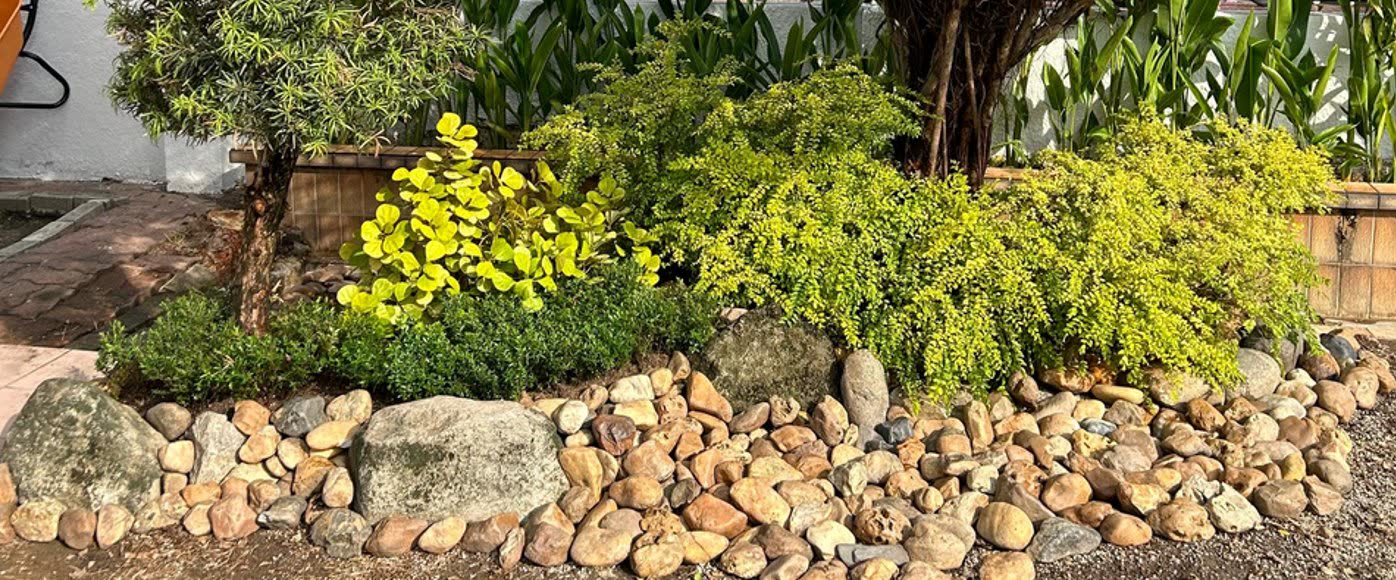
Nursery plants are babies. A foxtail palm in a bag is knee-high. Grown, it can stand taller than a two-storey house. The silver Bismarck palm that looks so neat in its pot wants a crown several metres across, which is most of a terrace house front garden.
Hedges are where this costs the most. Red-lip, or pucuk merah (Syzygium myrtifolium), is planted everywhere for its red new leaves. It is a tree by nature. Kept as a waist-high hedge it has to be cut again and again, for as long as the hedge exists. That can be a fair trade if you love the look. It should be a choice made with eyes open, not a surprise in year two.
We space and place for the size a plant will reach. The garden looks a little young on day one. That is the price of it looking right for the next ten years.
6. No bare soil
Bare soil in the tropics is an invitation. Weeds take it within weeks, the sun bakes it and the rain splashes it on to the paving and the walls. We cover it. In sun, a dense ground cover such as pinto peanut (Arachis pintoi) knits together quickly. In shade, mondo grass (Ophiopogon) is slower but very steady. Everywhere else, a thick layer of mulch, kept a hand's width away from stems and trunks. Mulch keeps roots cool, holds moisture and breaks down into food for the soil. It is the cheapest labour-saving device in gardening.
7. Edges that hold
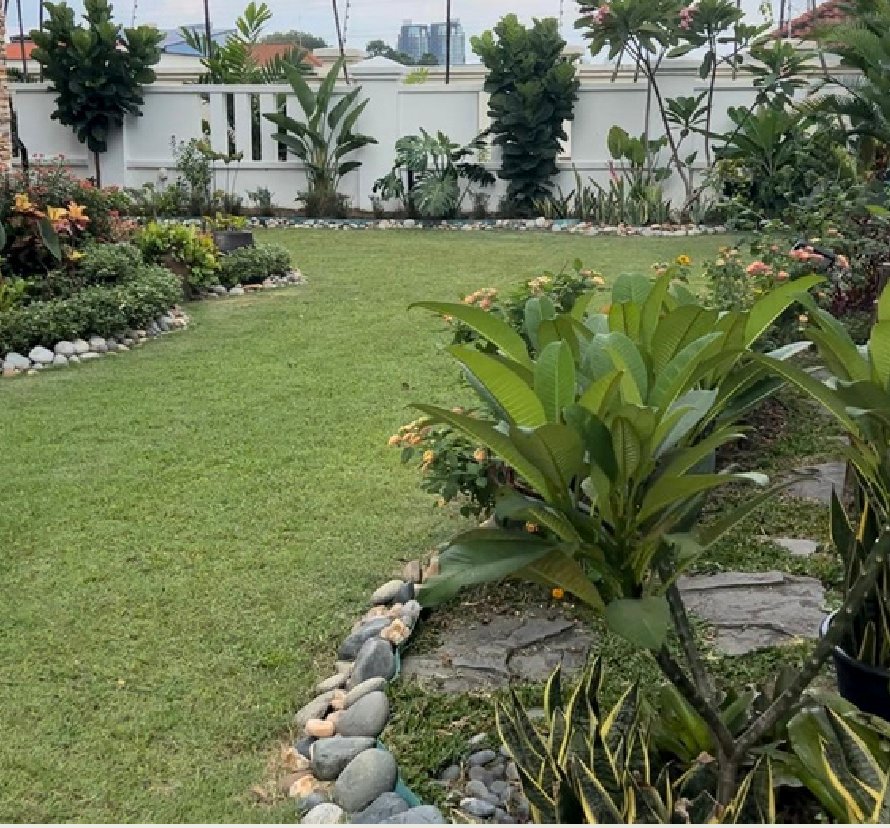
Lawn grasses spread by runners. Cow grass creeps over the surface, and Philippine grass travels below it as well. Give either an open border and it will be among the shrubs within months, and someone will spend years pulling it out by hand. A proper physical edge between lawn and planting stops that. A flush mowing strip of brick or concrete also lets the mower run right up to the line, so nobody has to come back with a strimmer.
8. Let the crew in
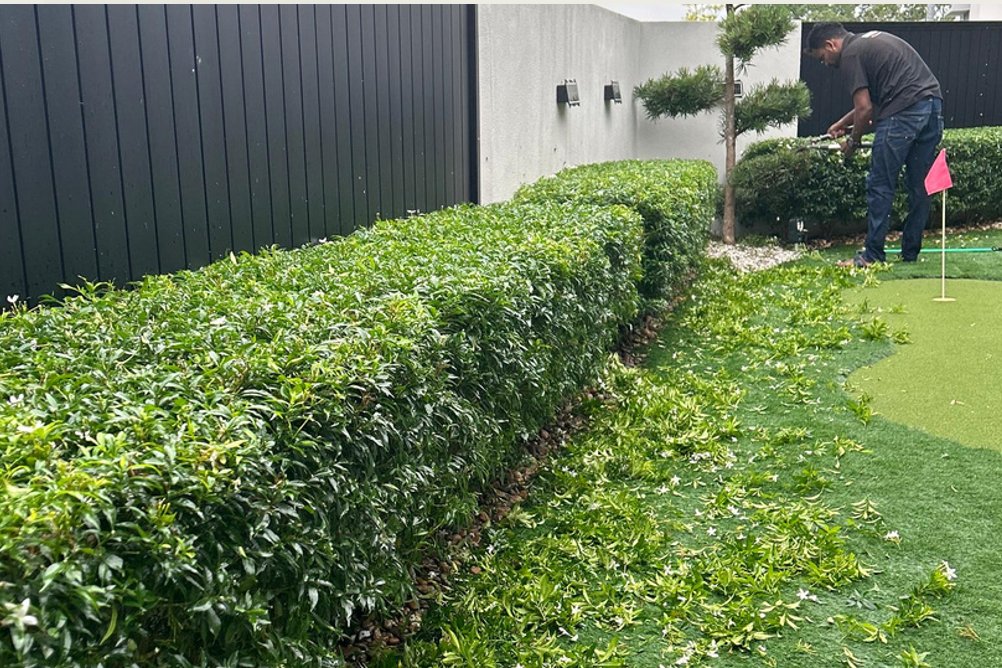
Somebody has to reach the back of that deep border to prune, feed and clear. If the only way in is over the front row, the front row gets trampled on every visit. We build in stepping stones, a service path behind the hedge and gates wide enough for a wheelbarrow. We keep hedges to a height that can be trimmed from the ground. Once a hedge needs a ladder, it takes two people, takes longer, and tends to get done less often than it should.
9. Water where you need it
A tap within a hose's length of every bed. It sounds too small to mention, until you watch someone haul fifty metres of hose across a pool deck twice a week. Where irrigation makes sense we plan the zones together with the planting, so that thirsty beds and dry beds sit on separate lines.
10. Mind the pool, the drains and the neighbours
Some plants are lovely and should still be kept away from certain places.
- Beside a pool or over a car porch: nothing that sheds all day. Bamboo drops leaves without a break. Bougainvillea sends its papery bracts wherever the wind goes. The fine-leaved Terminalia trees planted all over new townships, often sold as bucida, rain tiny leaves that are tedious to clear from water and from gutters.
- Beside drains, pipes and paving: no figs. The roots of weeping fig (Ficus benjamina) and its relatives go looking for water. They lift pavers and get into drains.
- Beside a shared fence: nothing that travels underground. Running bamboos and the small parrot heliconia (Heliconia psittacorum) spread by rhizomes, and they do not respect boundaries. Wedelia (Sphagneticola trilobata), the yellow-flowered ground cover, goes wherever it likes and is very hard to get back out.
There is nearly always a better-behaved plant that gives the same look.
11. Design the care with the garden
The maintenance plan is part of the design. While we are choosing plants we are already working out who will look after them, how often and with what. If the honest answer is more than the owner will want to do, we change the design. It is easier to change a drawing than to change a person.
What it adds up to
A garden designed this way asks for a little steady care and no heroics. It looks good on an ordinary Tuesday, not only on the day after the crew has been. None of the eleven is clever. Together they decide whether a garden gets easier or harder every year.
If you are planning a new garden, this is how we approach landscape design and build. If you already have a garden that eats your weekends, our garden maintenance crew can look after it, and tell you which of these eleven is costing you the most.